Friday, May 3, 2013

The Ladies' Guide to Cricket c1883

New Zealand cricket literature can seem like rare pickings at times. Yet occasionally it turns out curious and unusual gems. One such book is The Ladies’ Guide to Cricket printed in 1883 in Auckland.
A comic guidebook, an almost antiquated text, highlighting cricket watching to women (which is somewhat patronizing now) was written by a Lover of Both – a fine and witty pseudonym. It features a fictional match between “Shooting Stars” and “Paragons” (told in the form of a play script) and encouraged women to take an interest in the sport as well as challenging male preconceptions of their interest in the game.
The author is presumably William Eugene Outhwaite, an Auckland barrister, whose father Thomas Outhwaite (1805-1879) the first Registrar of the Supreme Court of New Zealand was ‘probably a father of music in New Zealand1. Bibliographers Rob Franks and A G Bagnall give William Outhwaite as a Lover of Both. Bagnall’s National Bibliography entry says: ‘Possibly by William Eugene Outhwaite, d. 1900’. The book also includes two cricket poems, which I included in A Tingling Catch (2010) and introductory dialogue verses. Adrienne Simpson first used one of these poems ‘Ten Ways to Get Out’ (in a misprinted or edited form) in her anthology Cricket (1996).
Recently, I started digging around for more information on Outhwaite. 19th century names are hard to find in histories as they come from a neglected era of the Kiwi literary psyche. Perhaps post Colonial guilt and political correctness shies away from discovering more on our early European poets and writers. A fair amount of derision has met them in the past for their alleged inauthentic ‘New Zealandness’; they are the archaic pioneers who came out from European countries in search of God’s Own Country; their verses have looked silly to baby boomers and others compared to recent constructions of Kiwi identity. Search tools, however, now bring up surprising results. It’s a researcher’s paradise for those still interested who continue to find early writers.
A number of details are traceable on Outhwaite’s life. His official death is 10 April 1900 aged 53. He was born in Auckland, New Zealand, in 1847. Some of his early child life was in Paris and London, and when he returned he was ‘an excellent marksman with the rifle’2 so signed on for the New Zealand Wars as a teenager at 15 (under the appointed age of 16) but did not see action.
He received a BA, Oxon, and was back in London according to the English Census of 1871 aged 24. He returned to New Zealand after he became a Barrister-at-Law of the Inner Temple, and in Auckland became a barrister of the Courts of New Zealand (admitted in 1890).
His painful rheumatism developing after an accident as a young man before heading for Oxford eventually prevented him from playing sport and athletics. An unsuccessful operation produced further stillness. He travelled to hot baths in New Zealand like Te Aroha’s waters in the mid 1880s as further restorative care and appeared either on crutches or in a wheelchair at some stages of his middle life.
There are in fact references to him in New Zealand newspapers playing cricket as a batsman and catcher in the mid-1860s for United Cricket Club at the Domain (alongside C Outhwaite and future first class Auckland cricketers Frank Buckland and Will Lankham) prior to England. Outhwaite also appeared for the Civilian XI v Auckland Garrison XI, one of the most interesting matches of the 1865/66 season; his brother C Outhwaite excelling as a bowler. At Oxford, he was in the Oxford First XI as a student.
An obituary from the Observer gives an account of his life, some brief facts and notes his paralysis after a break (a light-carriage) accident that lead to his eventual, untimely death, his body unable to recover from the shock:

We regret to chronicle the death of Mr. W. E. Outhwaite on Monday last. His figure was for very many years a familiar one at the Choral Hall and Opera House, and also at athletic sports, and his many friends in both the journalistic and dramatic profession, will mourn his demise. Mr. Outhwaite, although trained as a barrister, had, for a number of years, devoted his principal attention to literature, his unfortunate infirmity precluding his practising in court. As a writer, he was best known under the nom de plume of ‘Orpheus’, and his kindly criticisms will long be remembered by theatrical people. He took his degree at Lincoln College, Oxford, and while there, contracted rheumatism, which eventually developed into ossification of the joints. Although a great sufferer, he was invariably cheerful. He was a great lover of sport of all kinds, and would watch a cricket match or a horse race with as keen an interest as anyone present. Some few months back, he met with an accident, a bus wheel running over his leg and fracturing the bone. He never recovered from the shock, which was finally succeeded by paralysis [from bronchitis], the immediate cause of his death.
      (From The Observer, Volume XX, Issue 1111, 14 April 1900, Page 5)

A member of a prominent Auckland settler family, Outhwaite’s sister, Isa, was a well-known artist. She exhibited in Auckland from 1875 until 1900 and the family appears on Wikipedia with a note about William from the 1902 Cyclopedia of New Zealand: http://en.wikipedia.org/wiki/Outhwaite_Family,_Auckland
It is also stated on Wikipedia that William with other members of his family was interred in the Catholic section of Waikaraka Cemetery, Onehunga.
Besides Outhwaite’s presumed authorship of A Ladies’ Guide to Cricket and his work as a theatre critic under the name of ‘Orpheus’ in New Zealand Illustrated Sporting & Dramatic Review, Outhwaite wrote poetry and a libretto for the cantata ‘Art and Mind’ (at the opening of the Free Library and Art Gallery in Auckland, Auckland Star, 19 October 1888).
A poem, a sonnet by Outhwaite ‘To Auckland’, appears in his considerable obituary in New Zealand Illustrated Magazine (1 June 1900) along with a photo of Outhwaite and his dog “Koko”. The obituary states: ‘as a poet and ardent lover of art — the beautiful and good, the witty and piquante in women, the innocence of childhood— drew many a sonnet from his pen.’ The sonnet below is an example of his work suggesting Outhwaite wrote a good deal more:

AUCKLAND: A Sonnet

Queen of the Ocean, Valley, Hill and Wold!
Thou sit’st enthroned, in Nature’s garb arrayed,
A verdure-robed, clematis-girdled maid;
Thy bosom nursing blossom-gems, to braid
Bright tresses, spun from out the heart of gold
Thou bear’st within; the while thine eyes behold
An everlasting Spring in plain and glade,
Yielding health, plenty, peace, and joys untold!

Who once hath clasp’d thy gentle, loving hand,
May view the wonders of an older world;
May linger long in many a distant land:
But aye his spirit, wheresoe’er he roam,
Will restless burn to see those sails unfurl’d
That quick shall waft him back to Thee and Home!

This text given here (found by Niel Wright with more accurate punctuation) is in fact from The Observer (8 July 1882, p. 265) where the poem was unsuccessfully entered in an Auckland poems competition.
There is also in the New Zealand Illustrated Magazine obituary a lively description of his affinity for sports like cricket:

Heroic in his manliness and patience, he took all his trials as God-sent. As a keen lover and patron of all sport, he extended a wide and popular influence; no more familiar figure than that of Willie Outhwaite with his dog “Koko” was known on the cricket ground, while often to his room would throng young athletes for friendly chat or advice. Delighting in whist or billiards, ready always with guitar, song or story, his wonderful spirits, flow of language, and inexhaustible store of information, made him an ever agreeable companion.

A reference is made to his early cricket playing days:

As a young cricketer, picked to play in the best matches, he carefully practised and cherished the noble game, and would carry home his bat only to take up his cello, his special instrument, for some rehearsal or concert.

Outhwaite on his return to Auckland was associated with meetings in the late 1880s till late 1890s of the Gordon Cricket Club, the Grafton Football Club and the Auckland Cricket Association (as a Vice-President). Professor Carl Schmitt (who wrote the music for the cantata ‘Heart and Mind’ to which Outhwaite contributed his libretto) was also involved with the Gordon Cricket Club as a Vice-President. The Gordon club was ‘evergreen’ and a senior championship winner in Auckland cricket (The Press, 6 October 1894).
As to the Ladies’ Guide itself, I would call it a mixture of non-fiction, reference material and play script. Most of the references in it are English. The main story of the match between “Shooting Stars” and “Paragons” on a Saturday at the Green Acre cricket ground is in the form of a play with the following cast:

- Mr Stanley, captain of Shooting Stars Cricket Club;
- Mrs Chester, a widower of Captain J E Chester;
- Miss Linton, younger niece of Mrs Chester; and
- Mr Lover, a gentleman spectator.

The story unwinds with Mr Stanley outlining the start of play to the two women. The next two chapters feature Mr Lover commentating on the match, describing the finer details to the two women as well as striking up a love connection with the beautiful Miss Linton. A scorecard for the “Shooting Stars” innings follows and a postscript notes the eventual marriage of Mrs Chester and Miss Linton to Mr Stanley and Mr Lover respectively – duly married by a Rev. Canon Blessom no less.
Preceding the play is a short ‘preliminary canter’ outlining the necessity for the book to impart useful knowledge for women’s understanding of the game, particularly those with no previous knowledge of cricket. Despite their eagerness to learn, the ‘average lady spectator views the finest cricket pretty much as Peter Bell [Wordsworth’s creation] regarded the beauties of nature: “A primrose [by a] river’s brim3 / A yellow primrose was to him, / And it was nothing more.”’ Giving reasons for women’s continued involvement in the sport, it also notes that the controversial introduction of ‘round-arm bowling’ came about from the actions of a woman. ‘A Miss Willes ... found her flowing skirts very much in the way when delivering the ball in under-hand fashion’. After the play ends, there is a chapter on ‘Cricket at Ladies’ Schools’ and a full glossary of cricket terms and slang.
On evidence although we can’t be sure that a Lover of Both is Outhwaite, it does seem plausible for Bagnall to see Outhwaite as the possible author of A Ladies’ Guide for the following reasons:

- Outhwaite was a distinguished and witty theatre critic knowledgeable of written drama;
- Outhwaite was a poet publishing in Auckland in 1882 anonymously as seen by his poem ‘Auckland’ above;
- Outhwaite was a well-known follower of cricket in Auckland and England where he had lived for a number of years as a young man.

The Alexander Turnbull Library copy, which I have read (a red hardback first edition of 1883), came from ‘Goodson’s London Arcade … the great emporium in Auckland for watches, jewellery, and fancy goods’. W W Robinson, the Auckland and UK poet and sportsman, possibly sold it on at the time. There are two more copies in New Zealand at Auckland Libraries (donated by Sir George Grey) and Auckland War Memorial Museum Library (‘obituary and signed photograph of W.E. Outhwaite tipped in; also an obituary of his mother Louise Outhwaite’, suggesting it was Outhwaite’s personal copy and the strongest evidence so far for Outhwaite as creator).
I take it, from the recent sale price at auction at Christie’s in 2006, that it is indeed a very rare item:

Price Realized £2,160
Sales totals are hammer price plus buyer’s premium and do not reflect costs, financing fees or application of buyer’s or seller’s credits.
Estimate
£700 - £1,000
Sale Information Sale 5073
The Guy Curry Cricket Library
4 May 2006
London, South Kensington
Lot Description FREEMAN'S JOURNAL, publisher
The Ladies' Guide to Cricket by a Lover of Both
Auckland: Freeman's Journal Office, 1883. 12mo., 35, [5]p., with errata slip at end and advertising slip before title (title browned at margins), original printed wrappers (rebacked and repaired with losses to extremities), green cloth portfolio. Provenance: W.W. Robinson (pencil signature at head of text; extensive pencil notes in his hand; another half-erased pencil signature on front wrapper) -- Henry Edward Platt, Wellingborough (bookplate on title verso). VERY RARE, inscribed “only known copy”. Padwick 447.

Rowan Gibbs, who recently republished W W Robinson’s Rugby Football in New Zealand (1905) with an introductory biography on Robinson, sent me these auction details and also notes that ‘Platt was headmaster of Wellingborough School (where Robinson coached sport after his return to England) from 1879 to 1906.’
A review by “Argus” of The Ladies’ Guide to Cricket (the title perhaps a nod to popular books like Sylvia’s Ladies’ Guide to Home-Dressing and Millinery) appeared in the New Zealand Herald, 22 December 1883:

I have to thank the author of a very interesting and useful little book entitled “The Ladies’ Guide to Cricket; by a Lover of Both”. This little work is evidently a labour of love, and is written by one well conversant with the subject. It is simplicity itself, and might well be called the ABC of the best of old English pastimes. The description of the match “Shooting Stars” v. “Paragons” is most naturally drawn, and any “lover of both” will no doubt have answered most of the questions himself more than once. The chapter dedicated to cricket in ladies’ schools carries out what from my own experience I have found to be the case, viz., that with certain modifications in the game ladies can indulge in this pastime as they do in tennis and other recreations.
I remember well when a boy playing with a golden-haired fairy on a garden lawn, and though I was a left-handed bowler of some promise to the third eleven of a large public school, still the little lady, now a clergyman’s wife, could always hold her own against me. But I take it that the author’s principal aim is to make the game understood by the fair sex generally, so that instead of going to a match and coming away wearied, because possibly Stannie or Charlie has had to field all day, instead of basking in the sunlight of her eyes beneath the shade of her pretty parasol, as with half-closed eyes he watches the game, and whispers soft nothings into her shell-like ear --- Hold on “Argus,” you’re getting out of your depth. But, seriously, I mean ladies by thoroughly knowing the beauties and technicalities of the game, can enjoy it for itself alone; therefore I think many Auckland ladies will often thank “The Lover of Both” for his thoughtfulness in placing before them his glossary of technical terms, cricket slang, and laws of cricket contained in this handy little volume.

Here are Outhwaite’s presumed two poems from A Ladies’ Guide to Cricket included in A Tingling Catch, a lasting legacy to the game he obviously loved and played as a young man:

WILLIAM OUTHWAITE (c1883)

Ten Ways to Get Out

“Careful and clever that batsman must be
Who wishes to tot up a century.’
Ten different dangers hedge him about
By any of which he may be put out,
First ‘bowled’, second ‘caught’, and third ‘leg before’,
A fate that most batsmen dislike and deplore,
The fourth is ‘run out’, deemed very bad cricket;
The fifth if he clumsily ‘hit his own wicket’.
Stumped is the sixth, the seventh we’ll call
Foolishly touching or handling the ball.
Eighth is the striker ‘should hit the ball twice’
With malice prepense – a pestilent vice,
Ninth if he purposely spoils a fair catch
While running – and tenth, the last of the batch,
When jacket or hat, propelled by the gale,
Touches the wicket displacing a bail!”


‘Fair ladies at a cricket match’

Fair ladies at a cricket match
  Your gentle presence bliss is;
For even though we miss a catch,
  We yet may catch a missis!
Whilst in your sunny smiles we bask.
  Our form goes all to pieces:
You draw us out, then sweetly ask,
  Where are the popping creases?

Poems © A Lover of Both [William Outhwaite c1883]

Article © Mark Pirie 2013

Notes
1 New Zealand Illustrated Magazine, 1 October 1899.
2 New Zealand Illustrated Magazine, 1 June 1900.
3 Misquoted as “on the river’s brim”.

(Sources: Emails from Rowan Gibbs and Niel Wright; National Library of New Zealand catalogue; Papers Past; New Zealand Herald; New Zealand Illustrated Magazine; Wikipedia; Auckland War Memorial Museum Library catalogue; Auckland Libraries Catalogue; The Observer; and The Ladies’ Guide to Cricket by A Lover of Both, printed at The Freeman’s Journal Office, Auckland, c1883)


William Outhwaite


Cricket Society Journal reviews King Willow

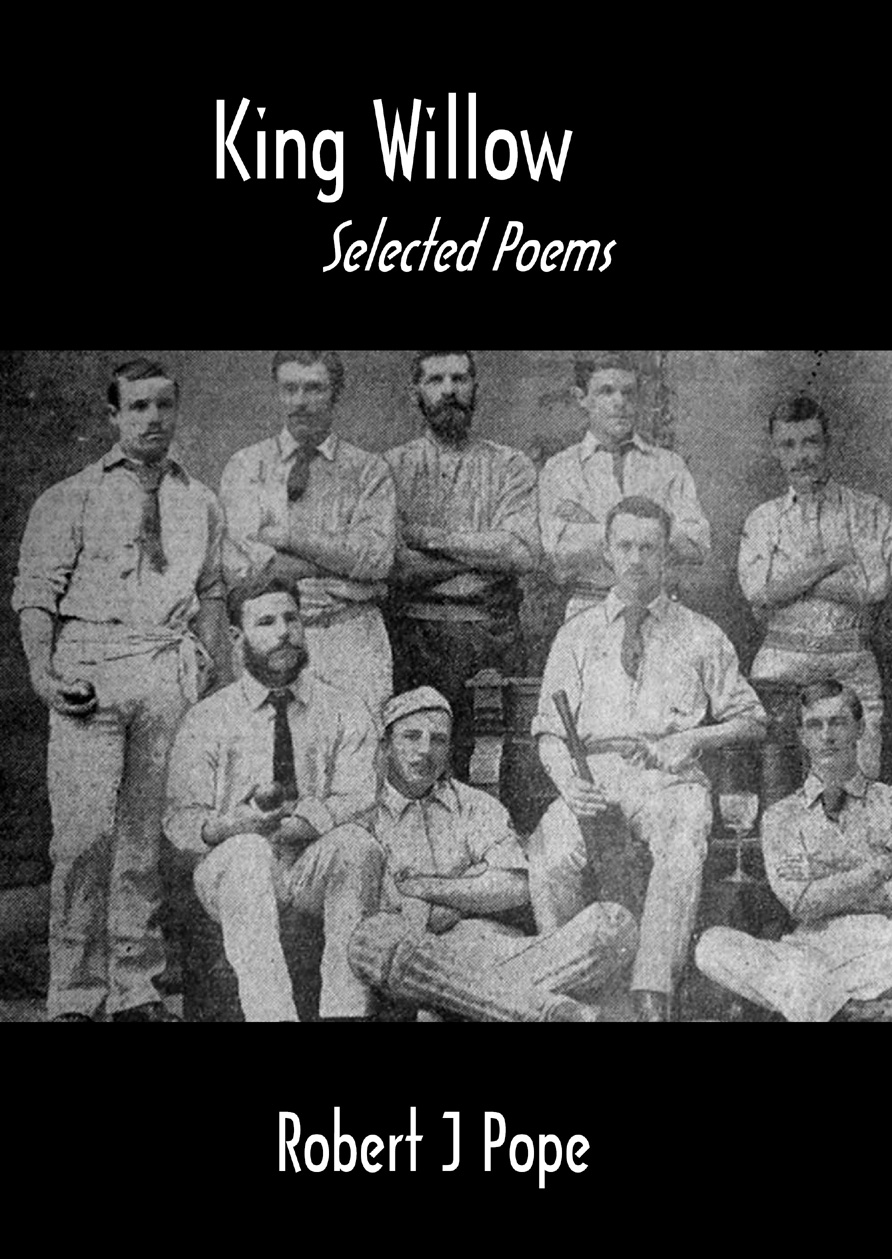
A brief but very good mention of the book I edited, King Willow: Selected Poems by Robert J Pope, appeared in the latest issue of the Cricket Society’s Journal:

JOHN SYMONS

Review of King Willow: Selected Poems by Robert J Pope edited by Mark Pirie
HeadworX Publishers, Wellington, New Zealand

Mark Pirie is continuing to explore New Zealand literary history both old and new and here we have a selection of poems from a writer, Robert J Pope whose life (1865-1949) covered the birth of New Zealand cricket through to Walter Hadlee’s determination on the post-war tour of England to be worthy of full-length Test Matches.
Although, well-regarded in his lifetime as with many poets, he became unfashionable although there now seems to be a reappraisal of his work. The selection from his work set out here contains only a single cricketing poem but his other work is well worth modern consideration. There is a wistful and elegiac tone to his war poetry – no drums and bugles and hurrahs – more sadness at lives lost and friends no longer to be greeted.
The only cricket poem “King Willow” was written to welcome in the 1932 season but there is a small section of cricket prose at the end of the book. I also liked his affectionate parody of W B Yeats in Billy’s Tea which made me smile.
Not really enough perhaps to convince the cricket collector to add this to his library but Mark Pirie is ploughing a singular furrow as he explores the byways of New Zealand literature and deserves the praise that he is garnering. A writer and a publisher who are always worth seeking out.

(From The Journal of the Cricket Society, UK, Volume 26, No. 4, Spring 2013, p. 69-70).


André Surridge’s new cricket tanka

André Surridge, a contributor to A Tingling Catch, recently wrote a new cricket poem (a tanka).
A tanka is a Japanese form of poetry consisting of five lines whereas a haiku is traditionally a three-line Japanese poem.
A tanka contains some of the qualities of haiku.
Surridge’s work is closer to senryu (humorous haiku):

ANDRÉ SURRIDGE

cricket stat -
the great W G Grace
was once dismissed
by Arthur Conan Doyle
now that's a mystery

© André Surridge 2012

First published by Tony Chad in Valley Micropress, Vol. 15, Issue 10, December 2012.

See also previous post on Surridge’s haiku:

Wednesday, February 6, 2013

Nick Whittock’s new cricket poetry The Doon

Last year, Nick Whittock sent me a copy of his latest cricket poetry book called The Doon, an exchange for a copy of Michael O’Leary’s Out of It that I published. It’s taken me a while to get on to it, but here’s a brief review of the book.

Review of The Doon by Nick Whittock (Vagabond Press, Australia, 2012)

Whittock is the author of the superb Covers, a collection of his very imaginative cricket poetry, one of my favourite cricket books. I’ve interviewed him previously for this blog on Covers.
The Doon, beautifully produced with Kay Orchison cover design/b/w artwork, is his follow up to Covers. It is a saddle-stapled chapbook by Vagabond Press in Sydney, Australia. It is a limited edition, a rare cricket and poetry book. My copy is No. 28 of 100 copies.
The cover sports an old, antique cricket bat, and ‘Doon’ in the title is presumably a play on ‘Don’ as in Don Bradman.
Bradman or his myth features in several of the poems here.
There are seven poems in total, including the poem ‘Don Bradman’. I first included that piece in A Tingling Catch in 2010. It is a monologue by a cricket spectator and recommends Ross Taylor as a ‘good fucking batsman’. As a Kiwi, I agree. It goes on to make comments about Twenty 20:

problem with 2020s not that it
dumbsdown cricket or its techniques
(in fact it enhances them all)
but the dumbing down of commentary…

Whittock’s technique is cut-up and Modernist, an element of Dada art involved. This can make the poems not as accessible as some other cricket poetry out there. The poetry texts require several readings to elucidate their ‘meanings’ and the jokes about beer are fair dinkum Australian, from the Rodney Marsh to David Boon era of the ’70s/’80s.
Throughout, the poems examine a contemporary Australian Bradman/Beeradman cultural myth effectively.
‘clara 81’ from Whittock’s Clara series (alluding to Brian Lara/Michael Clarke/Lara Bingle) reads like an elegy for former Australian captain Kim Hughes as ‘the people he could never be’. My favourite is ‘0s’ a poem about noughts in the scoresheet, published in the Sun Herald in Sydney in 2009. It ends by alluding to David Bowie’s ‘Heroes’: ‘blobs just for one day’.
The book concludes with the long, rambling ‘shane watson: becoming opening’ about Watto’s adventures as an opener. The poem conjures pithy one-liners, puns and word-play and fine imagery of a match v Pakistan (Yousuf, Akmal & Co). With plenty of clever allusions to Ricky Ponting, Stuart Law and Michael Clarke in the second section, it is rewarding.
I’ll end with the funniest poem here from a Kiwi perspective called ‘don bradmans wildly successful tour of nz’, a touring/holiday incident about camping in the Bay of Islands:

NICK WHITTOCK

don bradmans wildly succesful tour of nz

which cuntre ya callin cunt cunt
road trip to the baymarie of islands
minivan shadows tarmac
bob                    dylans a mothership

samuel becketts a mechanism
for opening
bottles scenerys cameras horse
                   stands on the earth

birds stand on the horse
things we cant see stand on the bird
n smaller things ride petes train
in the abscence of bathmats                   we stand on towels

the navigating was fucked
a crotchless cap for dickheads w
aids all over m penis w
unknotted condom                                  ooh! interesting soil
                                                              are you learning?

Poem © Nick Whittock, 2012

Anyone interested in the real Don Bradman’s 1932 visit to New Zealand, a similarly unrewarding spectacle, can read my blog article on it. Thanks to Nick for letting me reproduce the poem.
Copies of The Doon may be hard to get but the best bet is to try obtaining the book from Vagabond Press (http://vagabondpress.net/collections/rare-object-series)

About Vagabond Press: “Independent Literary Press since 1999. Based in Sydney and Tokyo, Vagabond Press is dedicated to promoting new writing in Asia Pacific. Over our first ten years we published many of the key emerging voices in Australian poetry. Over the next ten years we aim to publish and promote new prose, poetry and criticism from Asia Pacific.”

Review © Mark Pirie 2013

The Doon by Nick Whittock
(Vagabond Press, 2012)

Sunday, October 28, 2012

Cricket Society Journal reviews Out of It

Michael O’Leary whose cricket novel I edited earlier in the year got a brief but good review in the Cricket Society’s Journal. Out of It was re-released as a 25th anniversary edition through my company HeadworX:

JOHN SYMONS

Review of Out of It by Michael O'Leary (HeadworX Wellington,
New Zealand
)

If there has ever been a stranger book on cricket, I've yet to see it. I always thought that Willie Rushton's W G. Grace's Last Case was the strangest but this one .........................
Well, it's a reprint of a 1987 book which is apparently a 'cult classic.' The main story (?) is of a one-day match between a proper New Zealand side led by Jeremy Coney and a team named Out Of It. The latter team is skippered by the Maori chief Te Rauparaha with Bob Marley as Vice-Captain and the likes of Janis Joplin, Oscar Wilde, Jimi Hendrix and Hermann Goring playing (look, I'm not making this up!) with a running radio commentary from standard and made-up broadcasters.
It reads not unlike one of the earliest Dadaist offerings, written under the influence of hallucinogenics and although that almost certainly isn't the case, it may have been the author's intention to read as if it was. Perhaps it's about dislocation in society - perhaps it isn't. Maybe it's about a suburban man becoming unsettled in real life and entering the surreal world of the imagination - and maybe it isn't. It's unclassifiable (and occasionally, in parts, unreadable) but if you suspend disbelief, a kind of logic can be found.
It's not a spoiler to let prospective readers know that, unlike the song, Goring lasts for three overs and not the obligatory two balls, however small.
If you can find an inexpensive copy, you will have something in your collection that will be unique.

(From Journal of the Cricket Society, Volume 26, No. 3, Autumn 2012, UK)

Cricket Society Journal reviews A Tingling Catch

A brief review of A Tingling Catch appeared in the Journal of the Cricket Society in London. It's nice to be among 'the better offerings' in the collection of nearly 200 pages.

JOHN SYMONS

Review of A Tingling Catch - A Century of New Zealand Cricket Poems 1864-2009, Mark Pirie, Editor (HeadworX Wellington, New Zealand)
 
This is a reprint of the book originally published in 2010 and it's fair to say that the content is a little uneven, with a too-large number of parodies of other songs and poems, most of which seem to have been gathered by Sir Richard Hadlee in an earlier book, Hadlee's Humour, which certainly sounds like a contradiction in terms.
The poems are generally in blank verse (or as we used to say at school - "Sir - Sir - it doesn't rhyme Sir") although the works from earlier times are much more conventional. Poetry is perhaps one of the most subjective of all literary forms and, with the emphasis on things New Zealand; it's hard to know if there will be a widespread appeal for this selection.
The editor, Mark Pirie, contributes a number and they are among the better offerings, but the standout poem is from Jenny Powell, with ‘Under Cover’ which evokes memories of cricket and a relationship shared at the Carisbrook ground with an underlying feeling that the relationship was becoming as sterile as some of the play. Dispassionate with a slight air of wistfulness, this is an unsettling piece and I will look to read more from Jenny Powell. Bonus points to David McGill for attempting a limerick that gets lines to rhyme with Adam Parore.

(From Journal of the Cricket Society, Volume 26, No. 3, Autumn 2012, UK)

New selection of cricketer Robert J Pope’s poetry

This is my first post for a while. The new cricket season has opened in New Zealand.
Over the past three months I’ve been putting in the hard hours on a new selection of Wellington club cricketer Robert J Pope’s poetry to be published in November 2012. The selection also contains his club cricket essay on his days as a cricketer for the Star Club from 1884/85 till 1888.
Pope played in the Senior Pearce Cup competition as an opening batsman. This was the leading club competition in his day. Star Club won the cup twice: 1883/84 and 1884/85 seasons. Pope later played for the Wellington Cricket Club and the Wairarapa Cricket Club and learnt his school boy cricket under J P Firth at Wellington College.
Members of Pope’s Star Club team included Wellington slow bowler Charlie Dryden as well as Harry Roberts and Sid Nicholls, the fathers of future All Black footballers (i.e. Teddie Roberts and the three Nicholls brothers, most notably Mark Nicholls of the Invincibles 1924/25 team).
The book is 192 pages in total.
I will post more details on the book’s release.