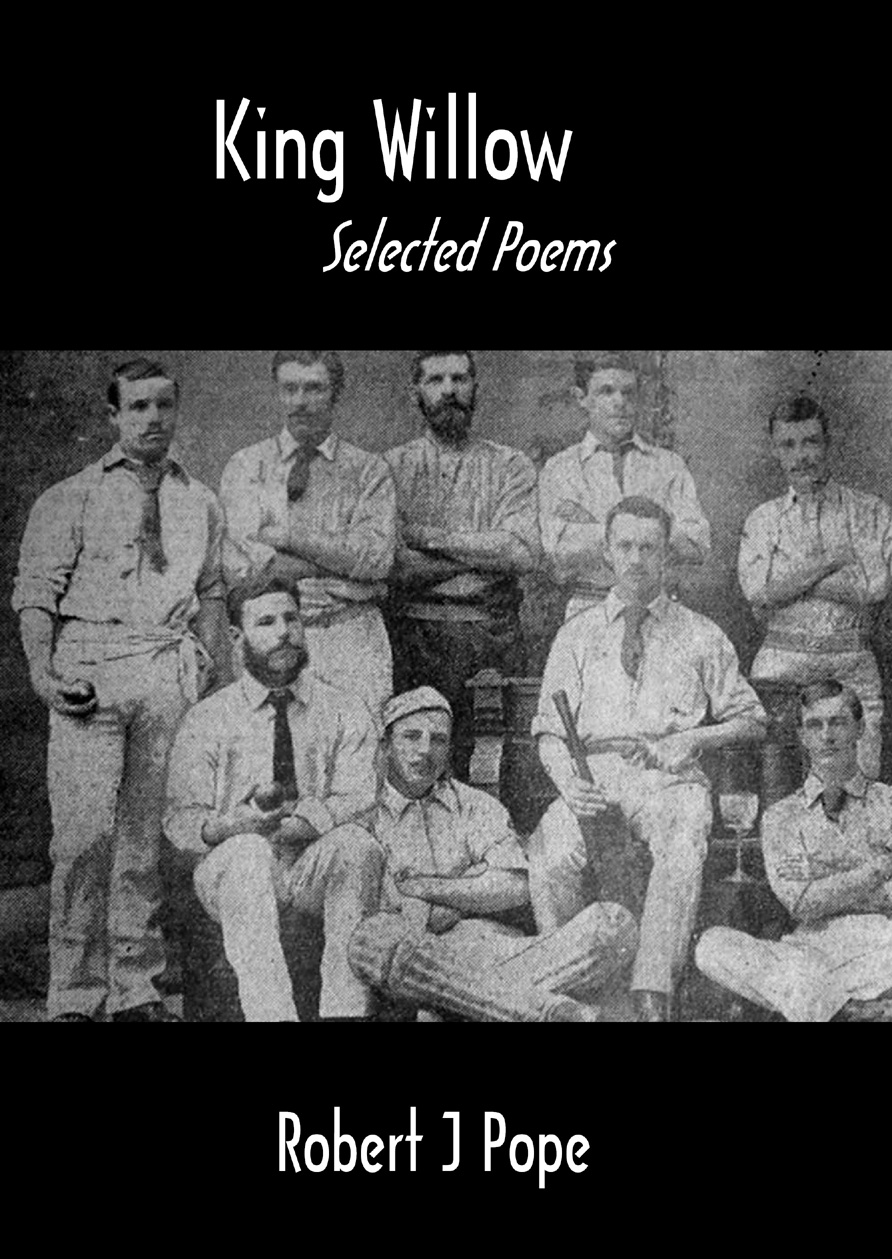
This month I reissued Wellington, New Zealand, cricketer/poet/songwriter Robert J Pope's poetry collection, King Willow: Selected Poems, as a free ebook pdf download from my website: www.markpirie.com
King Willow was originally produced as a small run archival limited edition in the HeadworX Publishers Classic Poetry Series in 2012.
Here's the link to access the free version of the book:
http://www.markpirie.com/books/king-willow-selected-poems
Reviews of this book appeared in a previous blog post.
Showing posts with label Robert J Pope. Show all posts
Showing posts with label Robert J Pope. Show all posts
Saturday, December 14, 2013

Sunday, December 8, 2013
Reviews of Robert J Pope’s King Willow
Last December I launched/published a book of poems, King Willow, by the late, forgotten Wellington poet, cricketer and songwriter Robert J Pope (1865-1949).
Pope’s neglect is common enough for New Zealand poets. Their reputations exist during their lifetimes and very few are enduring. However, more increasingly digital texts of these early poets are available online. I am now working on making a digital ebook pdf of Robert J Pope’s poems for distribution online.
In the meantime, watch this space. Here are two excellent reviews received on publication of Pope’s book this year, showing he still has plenty of relevance as a poet to today’s readers:
HAMESH WYATT
Review of King Willow: Selected Poems by Robert J Pope, edited by Mark Pirie, HeadworX Publishers.
Robert J Pope’s poem ‘King Willow’ appeared in Mark Pirie’s book A Tingling Catch: A Century of New Zealand Cricket Poems 1864-2009 (HeadworX, 2010). It talked of the opening of the 1932 cricket season.
Pope was a well-known Wellington poet, cricketer and songwriter. He was born in 1865 and died in 1949. Pope wrote the famous school song ‘New Zealand, My Homeland’. Pirie has put together many of his poems. This selection gives a picture of the man and his times and restores a significant New Zealand poet.
These poems are not old, dusty stuff. King Willow traces a time when Pope began writing and publishing during the Edwardian era and spans two world wars. He put together sporting verse on the 1924-25 All Blacks Tour of Great Britain and France.
Growing up in Dunedin, Pope says in ‘Memories’:
…Twas there by the fireside my father sat
And I upon his knee,
Enthralled by the wondrous tale he told
Of the Old, Old Man of the Sea.
There my mother plied her needle oft—
Sure toll our rents supplied:
And yonder the spot where my sister fell—
She was the first that died…
King Willow is fascinating, even with the rather mannered quality to some of these poems.
(Otago Daily Times, 16 February 2013, p. 49)
ALISTAIR PATERSON, Editor of Poetry NZ
Review of King Willow: Selected Poems by Robert J Pope, edited by Mark Pirie, HeadworX Publishers.
King Willow, Selected Poems, Robert J Pope, edited Mark Pirie, is a scholarly piece of research - a timely and substantial publication.
It presents much of the work of Robert J Pope (1865-1949) who had largely dropped out of sight and might otherwise have remained so, as have many other poets who preceded Allen Curnow's 1945 A Book of New Zealand Verse and became overwhelmed by the latter's new orthodoxy.
In this respect, Mark Pirie has done stupendous work in rediscovering him (as he has many other writers) and bringing him back into notice. Pope certainly deserves such discovery and recognition.
A long term and substantial writer, he 'deserves' as Pirie says, 'recognition ... as a significant precursor to the urban 1950s Wellington Group'. This is an enlightening and extremely worthwhile publication. (Poetry NZ 47 (August 2013))
The Journal of the Cricket Society also reviewed it:
http://tinglingcatch.blogspot.co.nz/2013/05/cricket-society-reviews-king-willow.html
Friday, May 3, 2013
Cricket Society Journal reviews King Willow
A brief but very good mention of the book I edited, King Willow: Selected Poems by Robert J Pope, appeared in the latest issue of the Cricket Society’s Journal:
JOHN SYMONS
Review of King Willow: Selected Poems by Robert J Pope edited by Mark Pirie
HeadworX Publishers, Wellington, New Zealand
Mark Pirie is continuing to explore New Zealand literary history both old and new and here we have a selection of poems from a writer, Robert J Pope whose life (1865-1949) covered the birth of New Zealand cricket through to Walter Hadlee’s determination on the post-war tour of England to be worthy of full-length Test Matches.
Although, well-regarded in his lifetime as with many poets, he became unfashionable although there now seems to be a reappraisal of his work. The selection from his work set out here contains only a single cricketing poem but his other work is well worth modern consideration. There is a wistful and elegiac tone to his war poetry – no drums and bugles and hurrahs – more sadness at lives lost and friends no longer to be greeted.
The only cricket poem “King Willow” was written to welcome in the 1932 season but there is a small section of cricket prose at the end of the book. I also liked his affectionate parody of W B Yeats in Billy’s Tea which made me smile.
Not really enough perhaps to convince the cricket collector to add this to his library but Mark Pirie is ploughing a singular furrow as he explores the byways of New Zealand
(From The Journal of the Cricket Society, UK, Volume 26, No. 4, Spring 2013, p. 69-70).

Sunday, October 28, 2012
New selection of cricketer Robert J Pope’s poetry
This is my first post for a while. The new cricket season has opened in New Zealand
Over the past three months I’ve been putting in the hard hours on a new selection of Wellington club cricketer Robert J Pope’s poetry to be published in November 2012. The selection also contains his club cricket essay on his days as a cricketer for the Star Club from 1884/85 till 1888.
Pope played in the Senior Pearce Cup competition as an opening batsman. This was the leading club competition in his day. Star Club won the cup twice: 1883/84 and 1884/85 seasons. Pope later played for the Wellington Cricket Club and the Wairarapa Cricket Club and learnt his school boy cricket under J P Firth at Wellington College
Members of Pope’s Star Club team included Wellington slow bowler Charlie Dryden as well as Harry Roberts and Sid Nicholls, the fathers of future All Black footballers (i.e. Teddie Roberts and the three Nicholls brothers, most notably Mark Nicholls of the Invincibles 1924/25 team).
The book is 192 pages in total.
I will post more details on the book’s release.
Saturday, October 23, 2010
Robert J. Pope - NZ poet and cricketer
In January of this year I discovered two poetry books published by colonial poet Robert J. Pope, a “Kaiwarra” (now known as Kaiwharawhara) School Principal and Wellington cricketer (old Star club and Wellington Dunedin
Pope, among other things, wrote two poem tributes to the late Wellington College Headmaster and Wellington
Pope and Firth were noted Wellington cricketers. Pope features in A Tingling Catch with his poem 'King Willow', which was penned at the opening of the 1932 cricket season. In Pope's manuscript collection in the Alexander Turnbull Library there is a newspaper clipping on his cricket club days after the Star Club won the local Wellington league. Pope is in the list of notable cricketers of the club. Firth, unlike Pope, played First Class cricket from 1880/81-1885/86 and is the more well known of the two. Firth was an all-rounder for Nelson and Wellington with a top score of 56 as a right-hand batsman and he took 32 wickets as a left-arm fast bowler at an average of 8.06. He helped foster the development of cricket in Wellington.
Firth must’ve appreciated the poems and song. He was well known at the college for his morning verse recitations taken from the Spectator. In the Turnbull, I found, among the Robert Pope manuscript books, a hand-written note from J.P. Firth to Robert:
My Dearest Bob,
It was most kind to send me a copy of your verses, which I like very much. The dedication to me makes me feel very proud…
Your generous words will always be treasured and will give me never failing pleasure…
Yours sincerely,
J.P. Firth
Here are Pope’s verses for Firth:
Mourn for the Brave
1914-1918
To J. P. FIRTH, E.S.Q., C.M.G.
(Late Headmaster, Wellington College
(Published in the NZ School Journal)
Mourn for the brave,
That loyal steadfast band
Who sleep their last lone sleep
Far from their Native land,
Roused by their country’s call,
Unmindful of the cost,
These risked in Freedom’s cause
Their all – and nobly lost
With wreaths of laurel green
Sweet rosemary entwine,
Fit tribute to the dead,
Whose mem’ry we enshrine.
Mourn for the brave:
Now low in death they lie;
So long as Time remains,
Their glory shall not die.
They shrank not from the blow
That made the wide world quake;
They leapt into the breach,
And died for England
No more with kindling eye
Ambition’s height they climb;
They reached Life’s utmost peak –
The sacrifice sublime.
Mourn for the brave;
Though tears must vainly flow;
Our grief can ne’er repay
The boundless debt we owe.
What monument can we
To their great name upraise
Whose honours far transcend
The clarion voice of praise?
O let our off’ring be
A brotherhood so wide
That all the world shall know
‘Twas not in vain they died.
“The Boss”
(An affectionate tribute to Mr J.P. Firth on his retirement,
after nearly 30 years as Headmaster of Wellington College.)
Who taught us how to play the game,
How might and right are not the same,
That honest work is more than fame?
“The Boss.”
Who led us all to strive with vim,
To scorn all methods that were “slim”,
To prize a word of praise from him?
“The Boss.”
Who, happ’ning on us unaware,
When mischief dire was in the air,
Politely asked, “How will you square?”
“The Boss.”
Who from his modest six-feet-five,
Would hope in four-feet-two revive,
Thenceforth the proudest boy alive?
“The Boss.”
Who in our school-days sowed the seed
That blossomed in the Empire’s need,
And gave us Honour for our creed?
“The Boss.”
Who shared our joys of bat and ball,
Who roused us at our country’s call,
And won the hearts of one and all?
“The Boss.”
J.P. Firth was known after he retired as “The Boss”.
I note further that Robert J. Pope (1863-1949) was a regular contributor to the Evening Post and the NZ School Journal and had a reputation as a violinist and composer. His two books of verse published late in his life (Some New Zealand Lyrics (1928) and A New Zealander’s Fancies in Verse (1946)) appear to be the only poetry he published in book form. The two world wars had a significant influence on Pope's verse. He also wrote many prose works. His song ‘New Zealand, My Homeland’ was published in the School Journal and became used in schools from North Cape to the Bluff. There is a copy of the sheet music in the National Library of New Zealand. In 1970 there was newspaper correspondence over the song being made the National Anthem. I am currently preparing a fresh selection of his poems for publication.
Article © Mark Pirie, 2010
Below: Photo of Robert J. Pope, from The Evening Post newspaper, 1949.

Subscribe to:
Posts (Atom)