Showing posts with label Wellington College. Show all posts

Sunday, October 28, 2012

New selection of cricketer Robert J Pope’s poetry

This is my first post for a while. The new cricket season has opened in New Zealand.
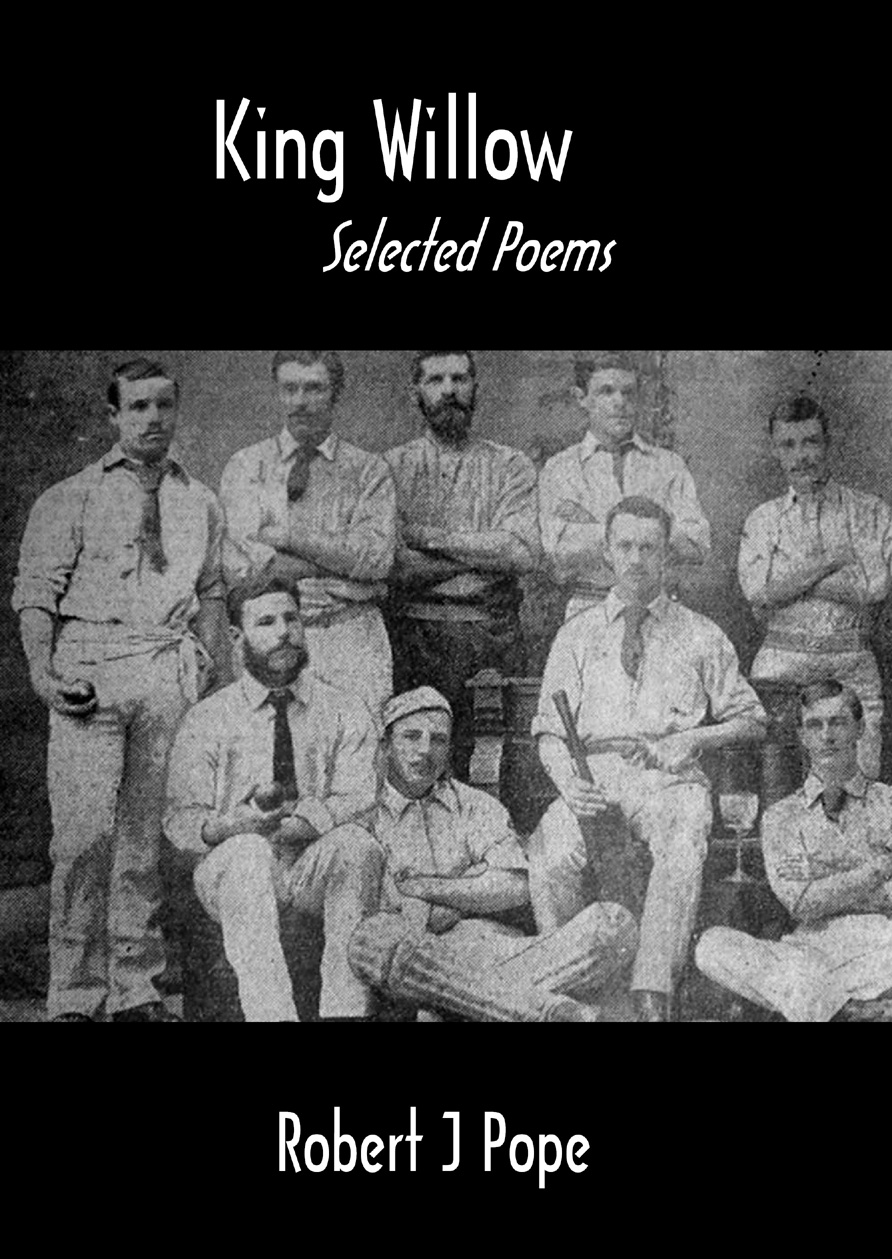
Over the past three months I’ve been putting in the hard hours on a new selection of Wellington club cricketer Robert J Pope’s poetry to be published in November 2012. The selection also contains his club cricket essay on his days as a cricketer for the Star Club from 1884/85 till 1888.
Pope played in the Senior Pearce Cup competition as an opening batsman. This was the leading club competition in his day. Star Club won the cup twice: 1883/84 and 1884/85 seasons. Pope later played for the Wellington Cricket Club and the Wairarapa Cricket Club and learnt his school boy cricket under J P Firth at Wellington College.
Members of Pope’s Star Club team included Wellington slow bowler Charlie Dryden as well as Harry Roberts and Sid Nicholls, the fathers of future All Black footballers (i.e. Teddie Roberts and the three Nicholls brothers, most notably Mark Nicholls of the Invincibles 1924/25 team).
The book is 192 pages in total.
I will post more details on the book’s release.

Wednesday, October 5, 2011

Ronald Castle’s NZ cricket related poem

A poem I found recently with cricket in it is by the late New Zealand poet Ronald Castle (1907-1984), a local Wellington chemist, writer and musician, who created a pharmacy museum in the 1970s. He was an old boy of Wellington College.
Castle’s poem is an elegant evocation of school days at Wellington College, where ‘On summery days on the green, white-flannelled cricketers batted’. As an old boy of the school, I very much enjoyed Castle’s poem.
I’ll share the poem with you here:

RONALD CASTLE

Man in the Faded Blazer

Weary, kindly old gentleman ambling slowly the pavement,
   That black blazer you wear speaks of collegiate days;
Lamp that eternally burns, in orange embroidery gleaming,
   Still have you treasured from youth, braving the fugitive years.
Know that I, too, at the back of some drawer filled with odd trifles,
   Found my tattered old cap, fronted by orange lamp.

What are your memories, leaping the chasm of the relentless
   Onward-hastening days? Sit you again at the desk
Watching the black board where geometric angles and circles
   Drawn with chalk-scratching sound, kind ‘Garry’ Lomas defined?

Or under Welsh Mr. Jones gowned in immaculate neatness,
   Drilled with phonetic symbols, could we ‘assassinate’ spell?
Learnt we from sad Alexander the rich Ovidian sweetness
   Ere he, dying too soon, boarded Charonian barge?

And what shall be said of the Master declaiming passionate verses,
   Still ignoring his wound, late from the trenches returned?
Lover of beauty immortal, and England’s sonorous language,
   Fired he many a youth, taught him poetical craft.

Now unremembered be good Monsieur Balham, tutor,
   With Gallic accent pure, gesticulating hands,
Coaxing unlikely lads from that ‘plume de ma tante’, still missing,
   On to noble Racine, chansons of dark Baudelaire.

What nauseous fumes emitted the attic science research room!
   Bubbled the glass retorts, Bunsen burners up-flared,
Dangerous phosphorous retrieved from water exploded like fireworks;
   Through the microscope tube we viewed the structure of worlds.

Still stands the observatory dome on the hillock behind the college,
   Where Doctor Gifford grave, his counter-poised telescope swung,
Sweeping the heavens antipodean, to pupils revealing
   Stars in endless space, galactic Milky Ways?

On summery days on the green, white-flannelled cricketers batted,
   Or on the tennis courts with resonant racquets smote:
While in the blue-tiled baths naked forms were swimming,
   And from the music-room came brass and cymbals sound.

This we knew and revered, O man in the faded blazer
   Black with the orange badge bearing the deathless lamp
Over its Latin script, motto engraved in our bosoms,
   ‘LUMEN ACCIPE ET IMPERTI’, from age to age.

Poem © Ronald Castle, 1983

(From The Select Poetry of Ronald Castle, Wellington, 1983).


Publications by Ronald Castle:
Fleeting Music, Wright & Carman, 1937
Arcadian Grove, Wright & Carman, 1939
Psaltery and Trumpet, Chapbook Publications, 1948
Old Instruments in New Zealand: a short survey of the Zillah and Ronald Castle collection of early and unusual musical instruments, Z & R Castle, 1969
Verses for Music, R B Castle, 1981
The Select Poetry of Ronald Castle, Castle Publications, 1983

Further reading: A Reading of the Poetry of Ronald Brian Castle by F W Nielsen Wright, Cultural and Political Booklets, 2001
Sunday, March 20, 2011

Marc Ellis as a cricketer

Last weekend’s Twenty20 Earthquake Relief Cricket Match at the Basin raised $500,000 for Christchurch. Well done to all those involved in organising the match. A full report was posted on Cricket Wellington’s website.
I was interested to see All Black Marc Ellis back on the cricket field. When I was at Wellington College, he was captain of our First XI (1989-90), a team that in those years was coached by former Wellington player Wilf Haskell and also included future Wellington all-rounder Stephen Mather and future All Whites midfielder Simon Elliott who impressed at last year’s FIFA World Cup in South Africa.
Marc Ellis was first coached by his father and cricket lover Chris Ellis ( who played for Kilbirnie Cricket Club and who gave Marc the cricket initials “MCG” Ellis). Marc was a schoolboy all-rounder, could bat and bowl and also kept wickets. At age 10 he played for a local Hutt Valley rep side at Wellesley College in Eastbourne. He was also an U18 Wellington rep. I was looking through my old copies of The Wellingtonian, the annual record of Wellington College, not to be confused with the community paper of the same name. There’s mention of Ellis as a wicket-keeper batsman in the 1988 season highlights: ‘M. Ellis 73 v Hastings’ and a partnership of ‘107 between Ellis (68) and Stephen Mather (49) v New Plymough Boys High School’. In the traditional fixture against Wanganui Collegiate, Ellis blazed 49 in the First Innings. Against Hastings, Ellis batted 'intelligently and with great flair’ in a 5th wicket partnership of 127 with Brian Watson.
The captain’s report by Alex Blades reads: ‘The First XI of 1988 was an impressive side. The team’s strength lay in its depth and diversity of talent: the batting line-up was strong and dependable, the bowling attack versatile and consistent while fielding was generally steady without being exceptional. Of its nineteen matches, the Eleven was unbeaten in all but two.’
I gather from Ellis's biography Crossing the Line that he played some club cricket after Wellington College but then gave up the game for rugby. He continued to play in the Auckland Business House cricket competition after retirement from rugby league and rugby. Ellis states: 'Of all the games I've ever played in my life, cricket is my favourite...I still play cricket now and I just love spending a whole day in the sun with my mates, having a laugh.' Ellis showed something of his batting ability in the earthquake charity Twenty20 making a useful 25 not out off 11 balls, including two fours and two sixes. His bowling was less successful with 41 runs taken from his two overs.
That same year of Ellis's cricket successes, 1988, the Wellington College Cricket Pavilion was opened at on the 15th of October by the then Governor-General of New Zealand Sir Paul Reeves. Those at the ceremony included former New Zealand batsman Johnny Beck who played against South Africa with Sutcliffe and Blair in the famous Second Test at the rugby ground Ellis Park, 1953/54 season. Sir Paul and John were teammates in the Wellington College First XI of the late 1940s.
Here are some of my own Wellington College cricket memories, composed in the form of cricket haiku, though traditionally haiku don’t have titles, I decided they work well nevertheless:

MARK PIRIE

Four Wellington College poems, late 1980s

1 Watching

mid game -
the terraces slowly filling
with disquiet

2 Net Practice

after school–
the small kid
bounced first ball

3 In the covers

big hit down the ground –
the tall boy sweeping
dries his forehead

4 Visiting Government House

jumping the fence
I retrieve the ball –
Sir Paul Reeves smiles

Article and poems © Mark Pirie 2011

(Sources: Wellingtonian 1988, Wellingtonian 1990; Marc Ellis: Crossing the Line, with Kirsten Matthew (Hodder Moa, Auckland, 2006) and Cricket Wellington's website)

Saturday, October 23, 2010

Robert J. Pope - NZ poet and cricketer

In January of this year I discovered two poetry books published by colonial poet Robert J. Pope, a “Kaiwarra” (now known as Kaiwharawhara) School Principal and Wellington cricketer (old Star club and Wellington club). Robert grew up in Dunedin and was the son of Henry Pope who founded the native school system.
Pope, among other things, wrote two poem tributes to the late Wellington College Headmaster and Wellington cricketer J.P. Firth (1859-1931) as well as music and lyrics for various songs (including a Wellington College school song).
Pope and Firth were noted Wellington cricketers. Pope features in A Tingling Catch with his poem 'King Willow', which was penned at the opening of the 1932 cricket season. In Pope's manuscript collection in the Alexander Turnbull Library there is a newspaper clipping on his cricket club days after the Star Club won the local Wellington league. Pope is in the list of notable cricketers of the club. Firth, unlike Pope, played First Class cricket from 1880/81-1885/86 and is the more well known of the two. Firth was an all-rounder for Nelson and Wellington with a top score of 56 as a right-hand batsman and he took 32 wickets as a left-arm fast bowler at an average of 8.06. He helped foster the development of cricket in Wellington.
Firth must’ve appreciated the poems and song. He was well known at the college for his morning verse recitations taken from the Spectator. In the Turnbull, I found, among the Robert Pope manuscript books, a hand-written note from J.P. Firth to Robert:

My Dearest Bob,
It was most kind to send me a copy of your verses, which I like very much. The dedication to me makes me feel very proud…
Your generous words will always be treasured and will give me never failing pleasure…
Yours sincerely,

J.P. Firth

Here are Pope’s verses for Firth:

Mourn for the Brave
1914-1918

To J. P. FIRTH, E.S.Q., C.M.G.
(Late Headmaster, Wellington College.)

(Published in the NZ School Journal)

Mourn for the brave,
   That loyal steadfast band
Who sleep their last lone sleep
   Far from their Native land,
Roused by their country’s call,
   Unmindful of the cost,
These risked in Freedom’s cause
  Their all – and nobly lost
With wreaths of laurel green
  Sweet rosemary entwine,
Fit tribute to the dead,
  Whose mem’ry we enshrine.

Mourn for the brave:
  Now low in death they lie;
So long as Time remains,
  Their glory shall not die.
They shrank not from the blow
  That made the wide world quake;
They leapt into the breach,
  And died for England’s sake,
No more with kindling eye
  Ambition’s height they climb;
They reached Life’s utmost peak –
  The sacrifice sublime.

Mourn for the brave;
  Though tears must vainly flow;
Our grief can ne’er repay
  The boundless debt we owe.
What monument can we
  To their great name upraise
Whose honours far transcend
  The clarion voice of praise?
O let our off’ring be
  A brotherhood so wide
That all the world shall know
  ‘Twas not in vain they died.


“The Boss”
(An affectionate tribute to Mr J.P. Firth on his retirement,
after nearly 30 years as Headmaster of Wellington College.)

Who taught us how to play the game,
How might and right are not the same,
That honest work is more than fame?
“The Boss.”

Who led us all to strive with vim,
To scorn all methods that were “slim”,
To prize a word of praise from him?
“The Boss.”

Who, happ’ning on us unaware,
When mischief dire was in the air,
Politely asked, “How will you square?”
“The Boss.”

Who from his modest six-feet-five,
Would hope in four-feet-two revive,
Thenceforth the proudest boy alive?
“The Boss.”

Who in our school-days sowed the seed
That blossomed in the Empire’s need,
And gave us Honour for our creed?
“The Boss.”

Who shared our joys of bat and ball,
Who roused us at our country’s call,
And won the hearts of one and all?
“The Boss.”

J.P. Firth was known after he retired as “The Boss”.
I note further that Robert J. Pope (1863-1949) was a regular contributor to the Evening Post and the NZ School Journal and had a reputation as a violinist and composer. His two books of verse published late in his life (Some New Zealand Lyrics (1928) and A New Zealander’s Fancies in Verse (1946)) appear to be the only poetry he published in book form. The two world wars had a significant influence on Pope's verse. He also wrote many prose works. His song ‘New Zealand, My Homeland’ was published in the School Journal and became used in schools from North Cape to the Bluff. There is a copy of the sheet music in the National Library of New Zealand. In 1970 there was newspaper correspondence over the song being made the National Anthem. I am currently preparing a fresh selection of his poems for publication.

Article © Mark Pirie, 2010

Below: Photo of Robert J. Pope, from The Evening Post newspaper, 1949.


Thursday, October 7, 2010

Mark Pirie's new poem The Umpire

The following cricket poem I wrote remembering a former teacher of mine at Wellington College was published in the latest edition of The Lampstand, September 2010 (the Wellington College Old Boys Magazine):

MARK PIRIE

The Umpire

Cricket often has its eccentrics.
In Form 7 at Wellington College

our form master Colin Froude was
taken as such. For one thing, he had

been in a motorcycle accident that
had left him with an ungainly limp.

As boys, we gave him hell for it.
But his redeeming quality was cricket.

We soon learned he was an umpire
in the local men’s grade. At the time

I had visions of him struggling to
raise his leg whenever a leg-bye

was scored. Luckily, the other
signals involved arms. Perhaps though

there was nothing that eccentric
about him. Anyone who’s a bit different

to the ‘norm’ can be taken this way.
Mr Froude (and his limp) will always be

part of my memories of the game.
Maybe he’s still out there on

a summer field signalling till the final run’s
scored, then handing back the bowler’s jersey,

he pockets the bails, pulls the stumps,
and starts his long limp back in to the pavilion,

a pat on the back, cheers from the players.
Nodding contented, a good day’s cricket.

© Mark Pirie, 2010

Thanks to Stephanie Kane, the editor, who does a great job collecting and printing stories and news from old boys of the college.

Saturday, October 2, 2010

The Lampstand article on A Tingling Catch

The First Ever Anthology of New Zealand Cricket Poetry

Wellington poet/publisher and Old Boy Mark Pirie (1987-91) has just brought out the first ever anthology of New Zealand cricket poetry, ‘A Tingling Catch’: A Century of New Zealand Cricket Poems 1864-2009.
The book to be released in September by Mark’s company HeadworX took Mark five years’ of research and extensive reading at both the Alexander Turnbull Library in Wellington and the Poetry Archive of NZ Aotearoa (http://poetryarchivenz.wordpress.com). He started work on the book in 2004 while he was compiling the first ever book of New Zealand science fiction poetry, Voyagers.
Voyagers, published by IP in Brisbane and co-edited with Wellington writer and editor Tim Jones, was the winner of Best Collected Work at the Sir Julius Vogel Awards this year and was considered one of the “Best 100 Books of 2009” in the New Zealand Listener.
Mark’s new cricket anthology contains much valuable and rare cricket material dating as far back as 1864. Poems by colonial poets feature amongst other elusive cricket gems from more recent times. Some of the finds of the book were poems by Robert J Pope (of the old Wellington and Star Cricket Clubs and a friend of Wellington College Headmaster J P Firth), William Pember Reeves, Thomas Bracken, Samuel Butler, Jim Tocker (of the former Old Collegians’ Cricket Club in Christchurch) and G P Williams. Don Neely, G Dewar and A E Sandford’s poems were found in the periodical NZ Cricketer published in the late ’60s and early ’70s.
Don Neely, local cricket historian and former Wellington captain, national selector and President of New Zealand Cricket, whose poem was an intro to a guest column for NZ Cricketer has also contributed the Foreword to the book in the form of another poem that was first published in The Summer Game: An Illustrated History of New Zealand Cricket. The poem ‘What is Cricket?’ was read earlier at the launch of Men in White in 1986.
Among the more well known poets in the literary world included are Allen Curnow writing as Whim Wham, Kendrick Smithyman, Alistair Te Ariki Campbell, Harry Ricketts, Brian Turner (brother of Glenn Turner), Alan Roddick (Landfall editor Charles Brasch’s literary executor), British politician and author Sir A P Herbert, Michael O’Leary, Elizabeth Smither, musician Bill Direen, and Campbell Live TV3 reporter Richard Langston.
Several college old boys feature such as Mark himself, Radio NZ National’s Jack Perkins and iconic ’60s poet David Mitchell. (David’s collection Steal Away Boy: The Selected Poems of David Mitchell was published this year by Auckland University Press.)
Mark has been a cricket enthusiast since he was a boy playing Junior cricket for Onslow Cricket Club, schoolboy cricket for Wellington College, and then senior social grade cricket for Hutt District Cricket Club (where he played a few matches for the senior reserves) and Wellington Collegians Cricket Club’s Axemen, a One-Day side.
In 2008 Mark published his own small book of cricket poems Slips, a collection of some of his best cricket pieces.
The book is distributed by Addenda Limited in Auckland and will be available from good bookstores nationwide. The best ways to obtain a copy are placing a special order with your local bookseller or visiting Unity Books in Wellington. RRP: $35.00.

(from The Lampstand, Wellington College Old Boys magazine, September 2010, p. 64)